
A conversation with InFormation founder David Temkin. Interview by Arjun Basu
—
THIS EPISODE IS MADE POSSIBLE BY OUR FRIENDS AT FREEPORT PRESS.
The tech industry is easy to dislike, admire, ridicule, resent, need, and all of the above. Look, this podcast doesn’t exist without tech.
But there is also no “enshittification” without tech. Coined by writer Cory Doctorow that word has entered the general lexicon with a speed and ubiquity that might make someone like, I don’t know, Shakespeare envious. If he knew what was going on. Which he doesn’t.
All of this to introduce InFormation, a magazine about tech, but more importantly, a magazine about “what tech is doing to us.” The people behind it work in the industry and so understand it, which makes them dislike it even more.
Twenty-five years ago, InFormation was like the Spy magazine of the dot com boom, a bit of a kick in the pants to an industry and a group of people who saw themselves in utopian if not messianic terms. And while they might still see themselves that way (spoiler alert: they most certainly do), a lot of people in the world do not, and so InFormation is back, it has reformed, and is being published again, with the same attitude, that is it continues to kick ass but with more feeling, because Silicon Valley is no longer a place but a mindset, techbros are a thing and a wealthy thing at that, and, well, there’s a general feeling that the world has been thoroughly colonized and completely enshittified.

Arjun Basu: I just want to hop right into this. So you had this 25 year absence with InFormation where nothing happened apparently. Let’s go back to what life was like 25 years ago. Describe the primordial soup of InFormation 25 years ago.
David Temkin: Late nineties, San Francisco, Silicon Valley. I was working in tech. I was working at a then-small company called Apple that was about to go out of business. I was an engineer and I’d been working in Silicon Valley and tech at that point for five, six years. Tech had been this thing where only a small number of people cared about it. It felt like we were working off in the colonies, outside of awareness of national, international focus.
Something started changing around the time that the internet became a consumer medium. All of a sudden you had this thing that came to be known a little bit later as the Dot Com Boom. What you saw from the previous era of computing, which was all about, Let’s make computers easier to use because people aren’t using them enough and there’s so much to be done here and wouldn’t that be great? That was the era of the personal computer shifting into, There’s this thing called the internet!
And that rapidly turned into two different related phenomena. One is the emergence of these companies that sounded like young upstarts, they said very funny, crazy things: Oh, everything’s going to change. You’re going to buy everything online and it will be shipped to you. You’re going to use the web browser to talk to people. Everyone is going to be online. We’re going to have a world of everyone talking to everyone. Everyone will be creating content—and all these things that sounded at the time completely fanciful and absurd.
There was a lot of hype around the value of these companies. They sounded like these propositions that made no sense. You looked at the guys who founded them, little nerdy guys doing things that sounded a little idealistic and maybe a little naive.
Everybody got obsessed with the internet. Everybody felt like, Wow, this really was some world revolution. It was going to save everybody. And so the hype became absolutely overwhelming. What had been we were off in the colonies, we were making personal computers, whatever we were doing. And suddenly this became an international phenomena. And both the absurdity of it, the claims that people were making—you could laugh at it, it was dying to be mocked and it was dying to be taken down—and at the same time, if you actually took it seriously this is some kind of dystopian stuff, if you understood what they were really talking about.
Arjun Basu: It was all couched in a very utopian vision. It was about possibility and human connection and if you went behind the curtain, it was about something else.
David Temkin: That’s right. We were going to have the global village and everything would be wonderful. And it’s not like you had people at that point in time correctly predicting or plotting out just how big this would be and what it would really mean to have these visions realized. But the visions were realized over a period of time.
Arjun Basu: So you and a bunch of people got together and said: let’s create this thing. Who were the players? Were they all from tech or were they journalists or where were they from?
David Temkin: Most of them were from tech. Most of them were people that I had worked with or met through, "Hey, we’re doing this publication. Do you want to be involved?" Most of them worked in and around tech. Key people on this were—and by the way, these were also the key people on the 25 year later issue, although the crew changed up a bit.
It was me. I started it. This is my idea and I got the band together. It was Alex Lash who was our executive editor, still is. Brian Maggi, who took the lead on humor, Paulina Borsook, Oren Tversky. These are people, some of whom were writing about tech, and had been for a while. Most of them were actually working in tech. They were effectively covering or making fun of. So it was like, participant/observer.
Arjun Basu: Who else was covering tech then, was WIRED around yet. Was there anything dedicated to the industry?
David Temkin: Yes. Actually, that’s worth talking about. So WIRED got its start in 1993, I believe. They were one of the very early publications to look at tech and take it like, Tech is culture. There were a lot of publications covering tech. You could go into one of the many stores that sold magazines and you would see multiple shelves of tech magazines.
And what these products were was, like, what is the latest product you can buy? What are their specs? How can you use it? What kind of printer do you want to buy? Top 10 printers, top 10 monitors or whatever it might be. There were a lot of tech publications.
WIRED, and a couple of publications earlier than that, something called Mondo 2000, now not as well remembered, started approaching tech from the point of view, This is a cultural phenomenon. This is going to change society. And they got into that. It was still very much a booster, techno-optimist kind of thing, but WIRED had something different.
So were there publications covering tech? Absolutely.
Arjun Basu:So you did two issues. Things changed. You didn’t do anything and now here’s issue three, 25 years later. So why now?
David Temkin: We’d like to think we’re the world’s first quarterly magazine. What changed? Let me rewind to why we didn’t do a third issue at the time. What happened was, we had published the second issue and it was very well received. It sold well. At that time you’re still in a pretty robust magazine economy. We had already locked in our distribution from the first issue. That got things moving much more easily.
But not long after that, we are going down this track of do we want to make this a commercial entity? Do we want to really try this as an ongoing concern and try and turn it into a business? Or is this going to be a sideline sort of thing?
We talked to a lot of people, but what happened was 9/11 really changed the focus of the culture. And it wasn’t just 9/11. Almost concurrent with that was Dot Com Bubble burst and all of a sudden the thinking was the internet’s not relevant. Actually this whole thing was just all bullshit, all of it.
And I would hear people saying, at that point in time, "The internet, going forward, it’s just a business thing. It’s only for businesses. People are not going to use it. All of that stuff was just a myth." And that was conventional wisdom at the time, then 9/11 happened. So the types of things we’re covering, the world that we had been covering really changed dramatically, and the shift in the culture’s concerns also changed.
Arjun Basu: So the why now question.
David Temkin: From that period forward, what ended up happening was—and I think everybody knows this, just as a general societal observation—all those dreams of the Dot Com era were realized. Some of them even larger than were even dreamed back then. And it came to dominate our lives, degree by degree.
At the end of 2022, ChatGPT went live. And what we saw starting at that moment—and it’s continuing until now, nothing’s really changed on this front—the hype around AI started to sound, feel, resemble what I remembered from the first when the internet was introduced as a consumer medium, right?
And so all of a sudden it starts sounding very much the same. It’s people making crazy, optimistic pronouncements coupled with: If you actually take this seriously, it’s a problem. Infinite money getting thrown into the ecosystem. And just an incredible amount of absurdity. So much of it is genuinely funny.
We see a lot more critical coverage now. The trigger was like, a friend of mine Alex Lash, he calls me, he’s drunk one night. He’s like, "So what do you think? Issue three. Special singularity issue."
And I’m like, “You serious?”
He’s like, “Yeah, I’m serious. Buzzed serious.” But I thought about that. Then not long after that I quit my job at Google and I’m like, “Tthis is actually a good idea. The time is now.”
Arjun Basu: Your editorial, you say something that I think, that warms the cockles of my heart: " the way to experience information is in print, because print just “smells better”—which I agree—and weighs more. It’s time for something different because AI reduces your attention span to microseconds. Put your phone down and touch paper." Great. I’ve often said to people, even when I was editing magazines, that magazines need to be printy-er. They panicked when the internet happened. Mostly because the ad dollars went somewhere else, but they tried to emulate the internet when they should have leaned in... which is a phrase that makes me think of bad people. But they should have leaned in.
David Temkin: It’s a part of this whole thing, right? Yeah.
Arjun Basu: Yeah, they should have leaned into their printy-ness. Having said that, InFormation might be the printy-est magazine we’ve come across. It’s remarkably self-aware of its nature.
David Temkin: Oh, I love the word printy-ness. I’m going to use that from now on. I will credit you to it. It’s very printy. Those of us who worked on it, we’re building applications, websites, infrastructure, all day long. We’re living and breathing that stuff.
And if you’re going to do a print anything, embrace the form and that’s what we did.
Arjun Basu: Even at the calliphon on the last page is basically, How we did it and what we did it with. And so you have all the typography. You have what you just said. "After 15 years deep in pixels and product design, returning to…" I mean, it’s just all there. You even have a vinyl record in here. One of those plastic things you can play. You’ve used every trick in the book. It’s large, and it feels great. The parody, just say it’s almost a parody. I’m not sure if it’s a humor magazine, just a straight humor magazine. It’s definitely commentary, but even the ads are parodies.
David Temkin: The ads. We have one real ad in the magazine, which is on the back cover. An ad for Espolòn tequila. Inside the magazine we have a fair number of ads, which are fake. We have a fake conference program and a fake corporate insert and a fake advertorial section with educational programs.
So a lot of that is: embrace the form of the print magazine, leverage that to get the message you want to get across. Trying to characterize this magazine, a lot of it is about the humor, but it’s dark too.
Arjun Basu: Of course it’s dark. That’s why this magazine exists. That’s where the humor is, in its darkness. It reminded me most of Spy Magazine.
David Temkin: Yep.
Arjun Basu: And so you have that Graydon Carter testimonial blurb on the website. That just makes the perfect sense. But InFormation is more subtle because it is talking about an industry where everything is possible. What you’re saying could be a joke, but it could also be deadly serious.
David Temkin: And you never really know.
Arjun Basu: Exactly.
David Temkin: You genuinely never know. I’m immersed in this stuff, and I don’t know. One of the authors is working at one of the world’s top AI labs. He doesn’t know. It’s interesting.
Arjun Basu: Wait a second. What? So he doesn’t know what?
David Temkin: Where’s this going to go?
Arjun Basu: He doesn’t know if he is working on a doomsday machine or if he is working on something to file your taxes?
David Temkin: If I talk to the people who I know, who are closest to the reactor core of the AI world, and these are the people who are working not on using AI, but on creating AI, they all sound vaguely manic right now. They sound a little bit crazy.
They say things that are not characteristic of their personalities before these roles. But they also vacillate between: is this thing going to achieve super intelligence? Or isn’t it? Or is it going to go this way? Are we going to see all jobs eliminated? Are we going to see more jobs created? I really don’t know. We’re just pushing it forward because it’s incredibly compelling. They’ve got some of the symptoms of actual mania.
There’s a thing called pressure of speech where you feel compelled to talk and to get words out at a high velocity. And it’s just a very interesting phenomena. So I think they’re compelled, they’re working on it. They’re not merely working on it. They’re obsessed with it, because it’s hard not to be obsessed with it, given the subject matter. And yet they don’t know where it’s really heading. I’m not sure filing your taxes, is the… like, we’re already past that notionally.
Arjun Basu: Yeah, we passed that a long time ago. I read a newsletter from an editor at a magazine that’s been on the show just this morning, and she said they are now getting inundated. And it was like the first cycle for them where they’re getting inundated with AI slop submissions.
David Temkin: Yes.
Arjun Basu: I know, literary agents, anyone who has to read an email for a living basically—or even not for a living—the amount of slop out there is truly discouraging.
David Temkin: It’s absolutely everywhere. You’re writing with a machine to be consumed by a machine.
Arjun Basu: Yeah. That’s why, when the people who extol the virtues of AI the loudest, one, they’re annoying people, but two, they don’t understand, like, how much it’s already impacted the normal person.
David Temkin: That’s something I’ve got a question about. I think it has impacted certain professions more than others. People who are dealing with words in large volume, I think absolutely. People who are dealing with art, I think so. But there are other fields where it’s still not really penetrated.
Arjun Basu: It hasn’t, and I think AI, the whole industry, would be really smart if they talked about the really good things it’s doing. Like in medicine, for example, or even science, but they don’t, because they keep pushing the language models because that’s where they think they’ll make the money. And I want to get back to the magazine.
David Temkin: Yeah. One of the things that ties into the magazine, it’s like, you have a world where, given AI, given the situation, you’re now talking about the slop... words have never been so cheap. And I mean that in a literal sense, right?
Arjun Basu: And that’s what makes the real words inversely so valuable.
David Temkin: Yeah. If you’re committing it to print, you made those words expensive. Those words are expensive and they have a different weight. They have a physical weight. You committed to them. And that was part of what we wanted to do.
Arjun Basu: That leads me to the question of, how do I put this? You have this whole thing of the evolution of the tech bro in here, which is hilarious. But like you said, there’s some really dark things. And I had to read some of the things twice before I realized they were both true and false at the same time.
As the editor, what are you looking for in a story? You and your team are essentially insiders who have managed to step back, who can see the forest for the trees, let’s just say.
David Temkin: Well, I’m glad to hear you think that. I guess, you know, when we would have our weekly calls it was interesting how the core group—when we would talk—everyone had a really good sense of, This is something that makes sense in the magazine and this is something that doesn’t. Even though it might be hard to explain.
There were a handful of pieces that we printed that could have been in The Economist. Most of them really couldn’t have been or would be highly unlikely to have landed in other publications. And some of that had to do with looking askance at what’s going on from a very well informed point of view.
There were people who wrote there who would never have written for a mainline publication. Not that publication wouldn’t have wanted them to write, it’s just they wouldn’t have known to contact them or anything else. So, well-informed. Looking at it skeptically. And having a bit of humor about it.
That magazine that you’re looking at there, if that were strictly like, Let’s be skeptical and critique Silicon Valley, I don’t know how far into the magazine you would’ve gotten. And it’s funny, I asked at the outset, I was like, having fun just like everyone was in 2023. I’m, like, describe the editorial mission of the magazine. I said, "Okay, hey, ChatGPT, go write me a table of contents and try to characterize what the tone of the thing is." And it complied.
And it was just fascinating how it completely complied with the request. And yet I looked at that table of contents. I’m like, no one would read anything on this list. Nothing. I’m not even sure I can exactly explain to you like, what is the center of gravity for this publication?
Broadly speaking, we are trying to do What is it that tech is doing to us? Just broadly speaking. And that may sound like a lot of things, but we had a particular way of doing it.
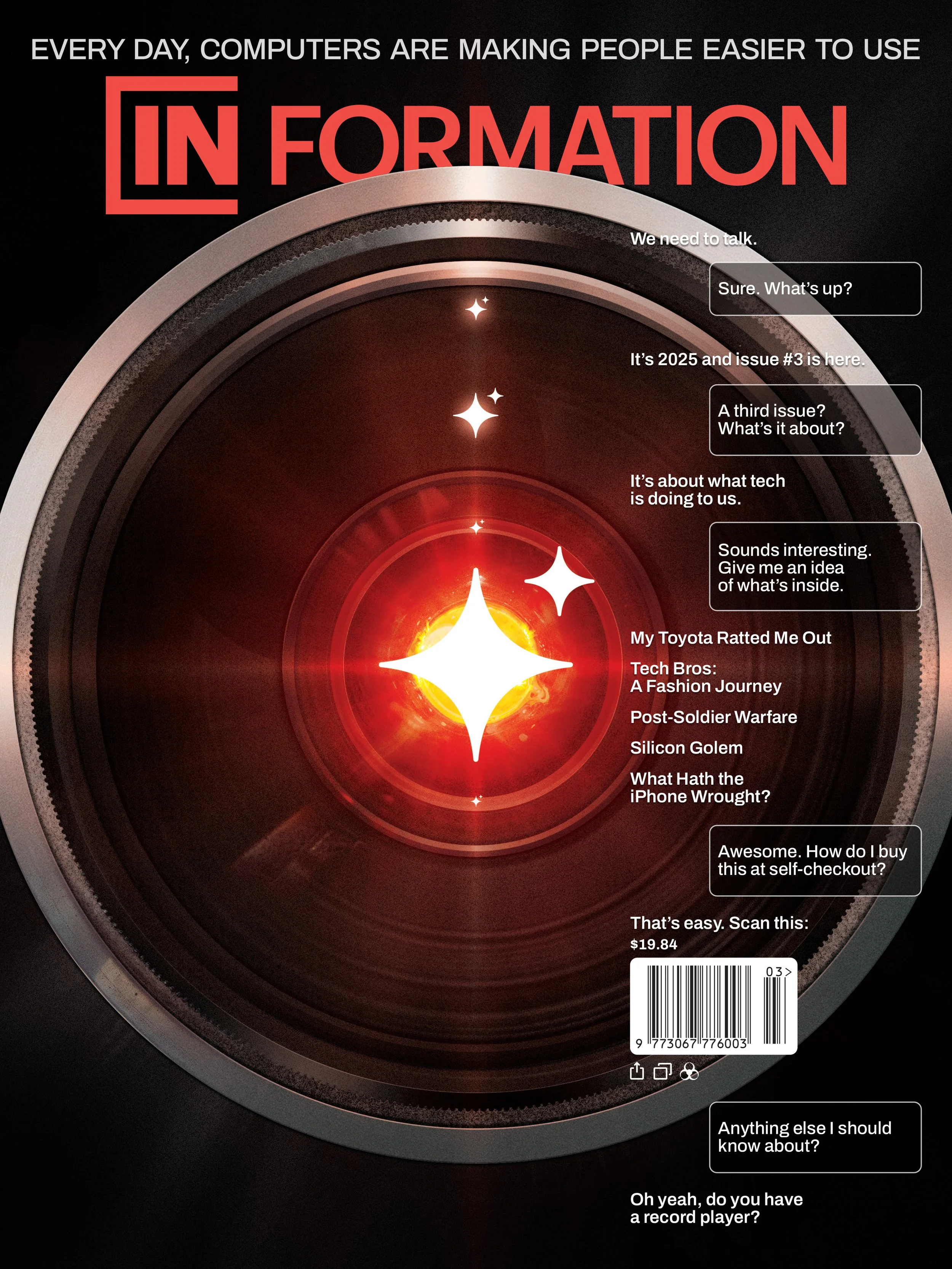
Arjun Basu: Just the cover lines—my favorite one and when I saw it, I just laughed so hard—it was ’My Toyota Ratted Me Out." And it is so funny because I can actually see that happening. To choose Toyota of all of the car companies to do that. Like every line of that is funny. Maybe it’s me because, just four lines down, we have “Silicon Gollum” so you get the idea of it, but you’re also like, okay, that’s actually true. How do I buy this at self checkout? I mean the self-awareness, it’s constant, and it really does succeed on that level. People were getting it 25 years ago. Do you think they get it differently now?
David Temkin: I think it’s really different now. I think 25 years ago, the appeal of this type of content was much more narrow. Or the people who were reading about it, they were reading about something that they weren’t living. It might be fascinating and interesting, but they were reading about a place and a set of ideas that they weren’t necessarily living and breathing.
And now everybody’s on their screens. Everybody is influenced by this. Everybody is hearing and probably directly using AI right now, which is one of the strangest things about it, right? You have this technology that’s rapidly developing, potentially dangerous, transforming humanity, compare it to nuclear weapons. People weren’t personally experiencing nuclear weapons, right, when they were being built? It was being done secretly by the government. And now these are consumer products. You can use it immediately.
I think this is something that is easier for people to absorb right now or more relatable. Relatable is a weird word, but I think everybody is living this now one way or another.
Arjun Basu: Yeah I think 25 years ago the pool of readers was niche and now it’s potentially everyone.
David Temkin: I don’t know if the attitude is for everyone. I don’t think it is, but the topics are.
Arjun Basu: Yeah, absolutely. Like a weird, funhouse mirror of LinkedIn.
David Temkin: Yeah, that’s another thing that’s totally mockable. Not that I don’t use it, I’ll admit.
Arjun Basu: Let’s talk about the design. We haven’t really talked about it because, going back to my print thing, it has everything that a magazine has ever had in it. Talk about the art direction and how you work with the art director.
David Temkin: A lot of what made this 25 year later issue what it is, is the design. And the guy who was our creative director—someone named Josh Klenert—he, like everybody else, he’s working in tech, he works at an enterprise software company right now. But if you rewind far enough, he was a magazine art director, a magazine designer.
And so he has a love for this. He lived through those years. And he hadn’t touched these tools in ages. But we went into it wanting to do, if we’re going to embrace print, let’s embrace print, let’s do things that can really only be done in print. Some of it is, Okay, you can use print as a alternate delivery mechanism for words. Just the facts, ma’am. It was just text on, like, plain paper. Okay. It’s no better or worse than a website. Although some people like the fact you’re reading on paper. Great. Okay. But we didn’t want to do that.
We wanted to embrace the form of a magazine and we wanted to do a magazine that reminds you of why you loved magazines when back in the day. They may not know that there’s a ton of indie magazines that would probably make them feel very similar.
But the sentiment was well taken. We wanted to embrace print and some of the things that we were talking about, like binding in the flexi disc. That was like, okay, the minute that idea came to mind, I’m like, all right, that’s, we have to do that. And it added significantly to the production costs, by the way.
Arjun Basu: I can only imagine.
David Temkin: There’s one thing that comes to mind in there. Facing pages have a side up and upside down page. You turn it around, you can’t do that kind of thing online. It’s just fun. And we have marginalia, right? Just really strange stuff. And also every little detail of it that on the design side was thought out and deliberate, right? We weren’t working on a hard deadline, so we had this luxury, right? And the team was, like, if we’re going to do this, let’s go all in. And Josh and his team just killed it.
The editorial direction of it came out of Josh said, all right, instead of structuring it like an old school magazine where you would have like front of the book, like quick hits and they have feature wheel back of the book. Let’s do something different because this is something approaching... not literally evergreen content, but you know, it’s not something where you’re giving someone nudes. The front of the book doesn’t mean anything. And we had a lot of ideas going on. How do you make this more digestible?
He proposed, "Let’s divide up the book into sections that are theme centered." And we did. I found that super helpful. I came up with the themes and even the names. And when he designed them, his group designed them, each of those sections has a little bit of its own visual identity. They have their own display font, they have their own highlight color. They just, all of those things, printy.
Arjun Basu: And that comes through. For magazine nerds or people who notice these things like myself, you start to notice what you’re talking about. All of these little details that I’m sure were the result of a lot of discussion or approvals or whatever. They all end up here.
David Temkin: You want to hear something funny about the design? Nearly killed me. All of the copy was done, everything was done. The headlines, the pull quote. Everything, and it was all being laid out, designed, illustrated, and we were headed into the final stretch. And Josh comes in and we spent a weekend looking at this stuff and we actually want to redo the design. Are you serious?
I’m like, “You’re going to do a redesign now?”
He said, “No. We’re just going to tweak it. We’re going to uplevel it a little bit. We want to make the pacing better.”
And I’m, like, “Shoot me now. Just shoot me now.” But guess what? It happened quickly, and it was a huge upgrade. So as always, he was right on these matters, and that’s where we landed.
Arjun Basu: The editor-art director relationship is fraught at the best of times. And if you don’t kill each other and are happy with the final product, then, of course, you won.
David Temkin: I have to say, I had three objectives here, which were: let’s all enjoy working on it, because no one’s getting paid; Let’s all feel good about the end product; And let’s put something out there that people enjoy and get people talking. The third one was discretional, but I have to say this team got along exceptionally well.
We didn’t have the throat choke kind of moments. My own stress about, Oh my God, late in the game, you’re going to do a redesign?? It was just, we have to ship, we have to ship this product.
Arjun Basu: So the cover, is that HAL or is that?
David Temkin: That’s…
Arjun Basu: Is it a camera?
David Temkin: Okay, so the cover, facially, it’s HAL, and yes, but I’m going to point out a couple things. because everything else in there, there’s details piled on details. It looks like you’ve got it in front of you there.
Arjun Basu: Yep.
David Temkin: So first off, you’ll notice that there are these little sparkles in the middle of HAL, which are the iconography that has emerged to indicate, Oh, look at my application with its cool AI feature. The other thing about the cover in terms of what is it is, go flip the page and look at the inside front cover.
So what you’ll see there. So you have HAL on the front cover with the little sparkles. You open the inside front cover and you see it’s a little pulled out. It’s the same image of that eye, but it’s on the back of an iPhone. And there’s a little story there, right? You do it to yourself. We all do it to ourselves.
Arjun Basu: Of course.
David Temkin: The cover was done by someone named Troy Dunham. He had been in magazine illustration for a long time, and then he’d gone into user interface design. That rendition, when we all saw it, we’re like, “That’s it, that’s the cover.”
Arjun Basu: Surely you’ve heard the word “enshittification.”
David Temkin: I have.
Arjun Basu: Which is one of those words that is perfect. And when Cory Doctorow came up with it, it felt inevitable and also it was a perfect word and you figured, like, why hadn’t we figured this out before? But of course, tech being tech, it entered the mainstream lexicon so quickly, almost as quickly as AI entered all of our lives. It really was that fast. And now of course he has a book out. Are you upset you didn’t come up with that word?
David Temkin: I love that word. Upset I didn’t come up with it? I don’t know. It’s certainly in keeping with the spirit of the magazine.
Arjun Basu: I think the magazine is basically about that subject, but just not as serious as Cory writes.
David Temkin: Is a wonderful word and it applies to a lot of things, right? You can be, like, anything I don’t like is being enshittified. But it does have a relevance right now. I do like that word, I’ll admit to it.
Arjun Basu: So do we have to wait 25 years for issue four?
David Temkin: Just a week ago we got the whole team together in San Francisco. People flew in and we’re, like, what’s next? There was this question, Is it going to be another 25 years? I don’t think that would go well. But if you look at issue one, there was a two year gap.
And then 25 years and then issue two, maybe there’s a two year gap tops. There will be another issue. Maybe next year. We don’t want to rush anything here. If it doesn’t outdo this one, it wasn’t worth doing.
Arjun Basu: This one obviously hit, it resonated because you’ve just reprinted.
David Temkin: Yeah, we did. We reprinted it, we sold out. We also sold out, at least online, of the reprint, which was great. But, retail sales are different and we could talk all about magazine sales and distribution.
Arjun Basu: Distribution sucks.
David Temkin: It does.
Arjun Basu: And it always sucks, and now it sucks even more for different reasons.
David Temkin: That is exactly right. We did want to get visibility in the retail world. Cast a wide net, you never know where it’s going to lead. And it does add some air of, and this is going to sound weird, legitimacy?
Arjun Basu: Absolutely.
David Temkin: We printed all of it without knowing whether we would get any, it was completely speculative and we’re rolling the dice. We think we’ve got a good product. We think we’re going to somehow move these magazines. And we did, but we didn’t know. You can’t talk to a distributor or a retailer about, Will you sell this product? unless they’ve got the actual printed copy in hand. Hey, I got a PDF. Not good enough. They need to feel the thing.
Arjun Basu: No, there’s a chicken and an egg. They can answer that question.
David Temkin: Yep. Yeah.
Arjun Basu: I’m happy to see that it still works and that it’s found its audience and hopefully it’ll find a bigger audience as you move forward. I think it’s a great publication.
David Temkin: Yeah. Thank you for that. I would love to reach a larger audience with this. I think we learned a little bit about how to get to people, but there’s no equation. It’s luck.
Arjun Basu: A lot of luck and more people need to admit that all success comes with a bunch of luck.
David Temkin: That’s certainly true in the tech business as much as it is here.
Arjun Basu: It’s true in every business and endeavor, I think. We end our interviews usually, by asking our guests about their three favorite magazines or media, so it can be anything. So what are yours?
David Temkin: Is a magazine published out of Barcelona in both Spanish and English. It’s an indie magazine called La Nueva Carne, and it is a side project of a design firm. The content is super interesting. A lot of it is in the domain of InFormation with a different angle. The design caliber, the cover, the quality of the content is great. And I’ve definitely enjoyed that.
Another one that I’ve enjoyed, which is different domain and partially just because of the format, is this thing called County Highway, which is a newspaper that they put out, I believe, once every month, two months. Just having something done in the form of a newspaper broadsheet with the type of writing that they do and the sort of oddball content that they have. Really refreshing.
going to leave it at two for now on that one.
Arjun Basu: Okay. Thank you for this. This has been great.
David Temkin: Thanks for having me on.
More from The Full-Bleed Podcast